


Introduction
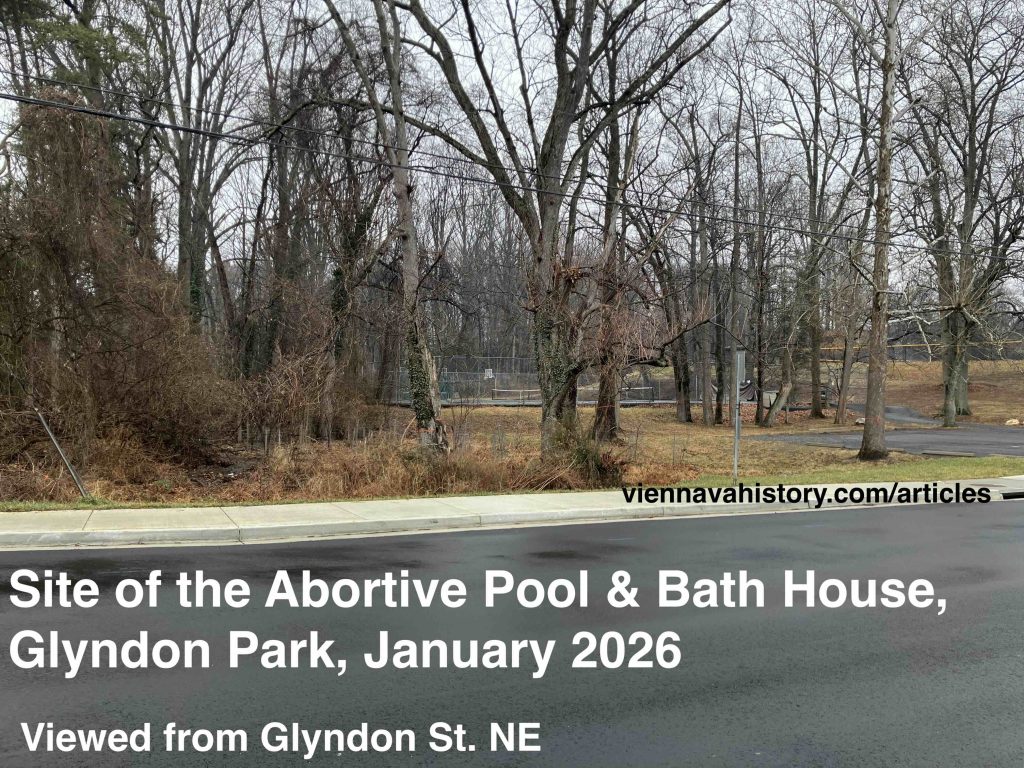
In 2023, the Town of Vienna began a campaign to consider building a municipal swimming pool, revisiting an issue that first cropped up in 1948, 75 years before.1 This post, the first of a two-part series, looks at that original effort in the late ’40s and early ’50s. Part 2 will cover the abortive push of the late 1960s and early 1970s, which failed under different circumstances.
Planning A Swimming Pool For “The Vienna Park” (Glyndon Park)
In mid-August 1948, Vienna’s American Legion post and the Vienna Lions Club both passed milestones in their separate efforts to establish a recreation facility in Vienna. To the Legion’s Dyer-Gunnell Post, Virginia granted a charter to build a recreation center for veterans of the world wars. The post’s plan was to include a swimming pool at the facility. Meanwhile, to the Lions Club, the Town of Vienna leased seven acres for what would eventually become Glyndon Park. The Lions Club hadn’t been aware of the Legion’s effort, but the Lions’ arrangement with the Town obligated the club to join forces with other local groups, civic and religious, to establish the park. Thus Dyer-Gunnell’s push for a recreation center with a swimming pool was subsumed temporarily in the Lions-led effort to establish a park on Glyndon Street in northeast Vienna.2
As the community groups were organizing themselves into the Vienna Recreation Association (VRA) in September 1948, it was clear that the first priority was a “picnic park” with a playground. However, equally clear was that the de facto second priority was “a modern swimming pool of the finest type,” as one local newspaper put it. (This was to be an outdoor pool, unlike the facility now under discussion in Vienna). In early September, when the civic groups held their initial meetings about recreational facilities, someone had done sufficient homework to answer with details a question about the feasibility of a pool. The pool would have filtering and recirculating equipment as well as a bathhouse. The estimated cost was $20,000-$50,000. The cost variation was based on the particulars of the pool’s features and how much material and labor would be locally contributed. The latter almost certainly referred to donated material and labor; that’s how the “Vienna Park” ended up being built. (Today, what was “Vienna Park” is named “Glyndon Park”). Pool advocates explained that financing could be via a large gift from an individual person, by many smaller gifts from a large group of people, or by a loan that pool receipts would pay back. Someone claimed that many community pools generated a profit that could finance other recreational facilities and that the fire department would benefit by getting potential access to a large supply of water.3
Within months, the VRA was gathering information, at first to refine the pool requirement. The VRA’s Swimming Pool Committee visited other pools in the region, met with their managers, and compiled data about designs, construction costs, and water—both its supply and sanitation. In January 1949, the Committee reported its findings. According to the Fairfax Standard newspaper, “it is estimated that a swimming pool featuring all the best modern developments in water sanitation, night lighting, adequate space for sun bathing and complete with dressing rooms and toilet and shower facilities can be built for from $70,000 to $89,000.”4
The second information-gathering exercise was to determine the preferences of Vienna’s residents. In February 1949, a VRA team went door-to-door in town to solicit interest in various recreational options, including a pool. The team interviewed 500 families and found that 83 percent wanted a pool, the feature of highest interest. This exceeded demand for a picnic venue (59 percent) and a playground (50 percent).5
The VRA leadership perceived that demand for a pool extended beyond Vienna’s borders, which in turn provided a funding opportunity. “There is no good modern pool available to the public between the Potomac and Leesburg, Virginia,” explained the Fairfax Standard. “The great need for a pool in this area is demonstrated by the large number of inquiries that have been made by individuals, summer camps, and schools since [the] Vienna pool has been under consideration.” The VRA’s Swimming Pool Fund Advisory Committee investigated how this need outside of Vienna could help to finance the pool. Among the ideas were advance sales of season tickets and 3-percent bonds in $25 and $1000 amounts. The hope remained that a private donation could offset a significant portion of the cost.6
Exploring Alternative Sites For The Pool
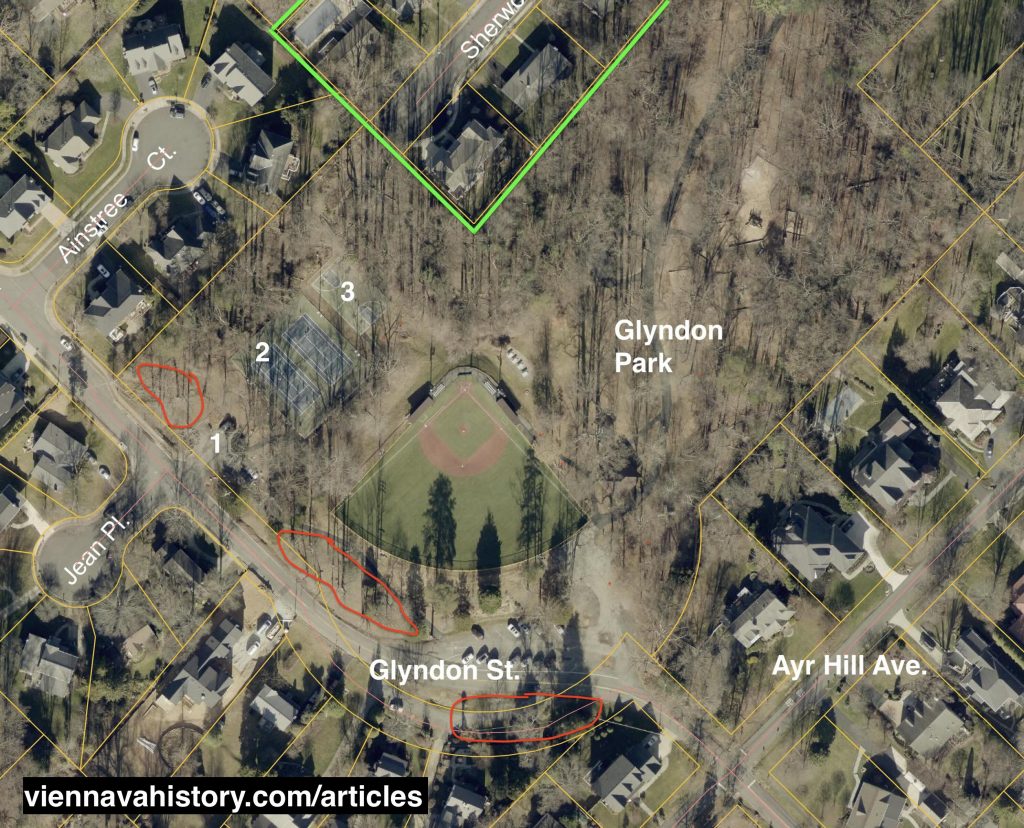
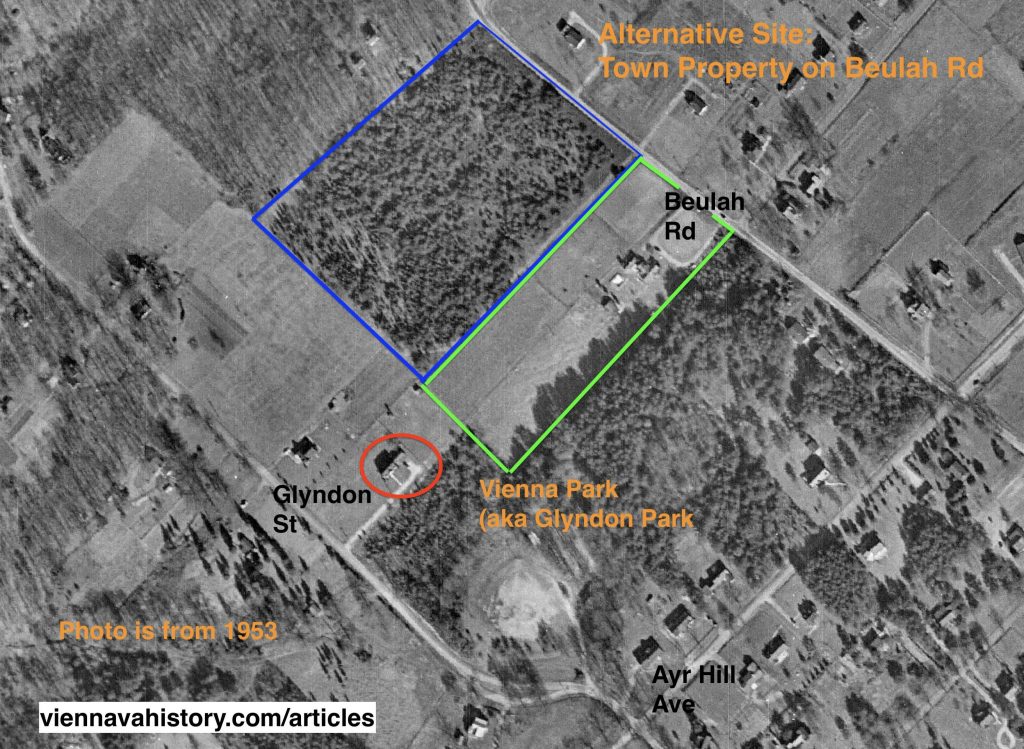
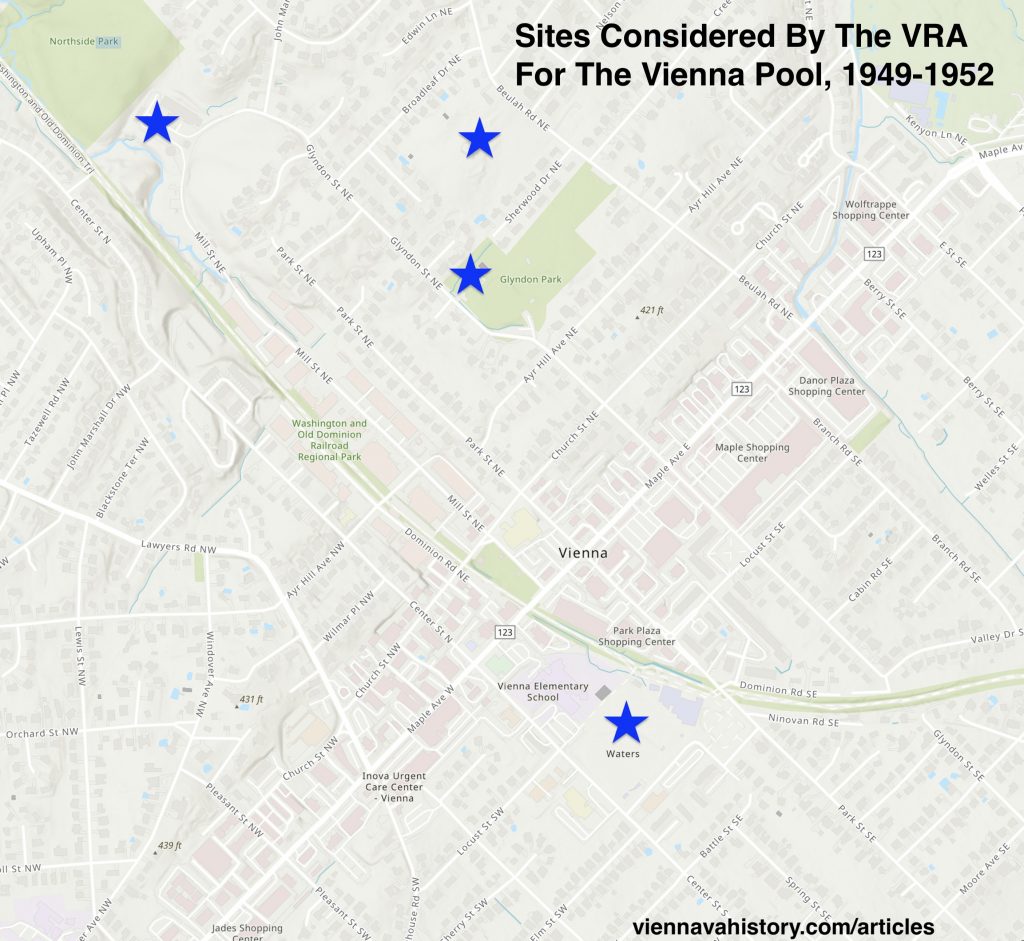
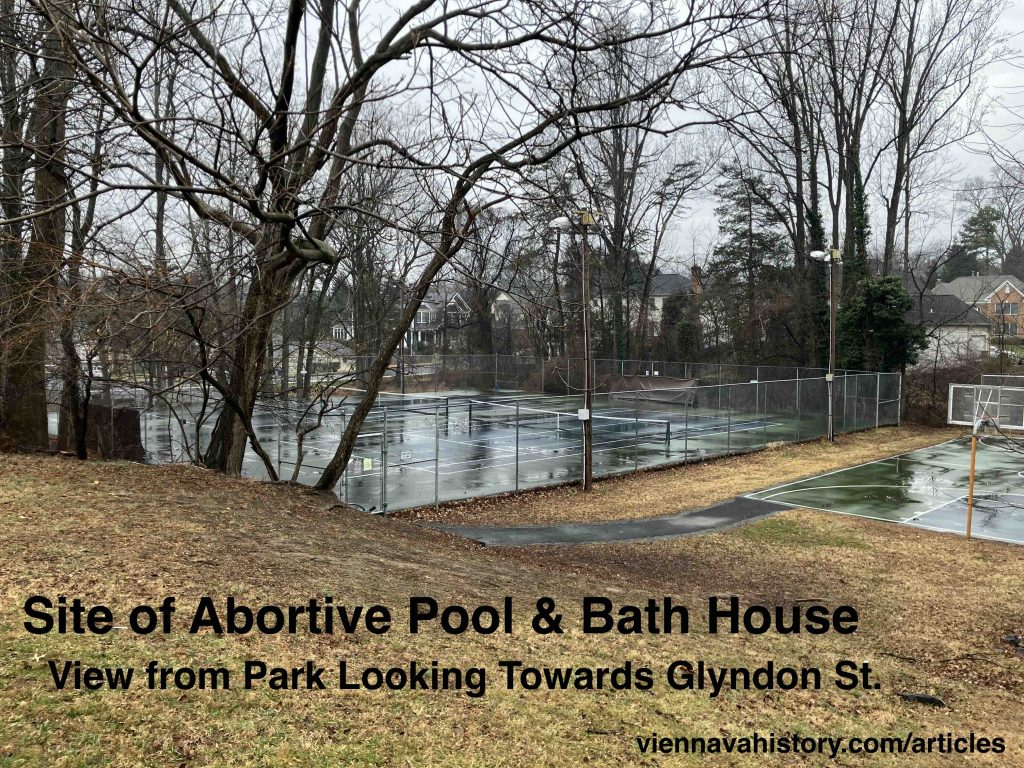
The Committee also advised the VRA in early 1949 that a pool needed a larger site than what was then available in the park on Glyndon Street. In the VRA’s original map of the park’s planned features, which was published in area newspapers in early 1949, the pool and bathhouse were to be crammed into the park’s westernmost corner about where the pickleball/tennis courts are today. [Be sure to check out the link above–it’s a great graphic from the time!] Thus finding a location for the pool became the focus for the next two years. As the VRA’s president, Harold Whitmore, informed the organization’s board in mid-1949, the plans for a pool depended on acquiring additional land. At first, the VRA had its eyes on a wooded parcel that was near their new park and encompassed approximately 10 acres. This parcel was probably the site on Beulah Road for today’s mulch yard. The Town of Vienna owned that lot, as it does today.7
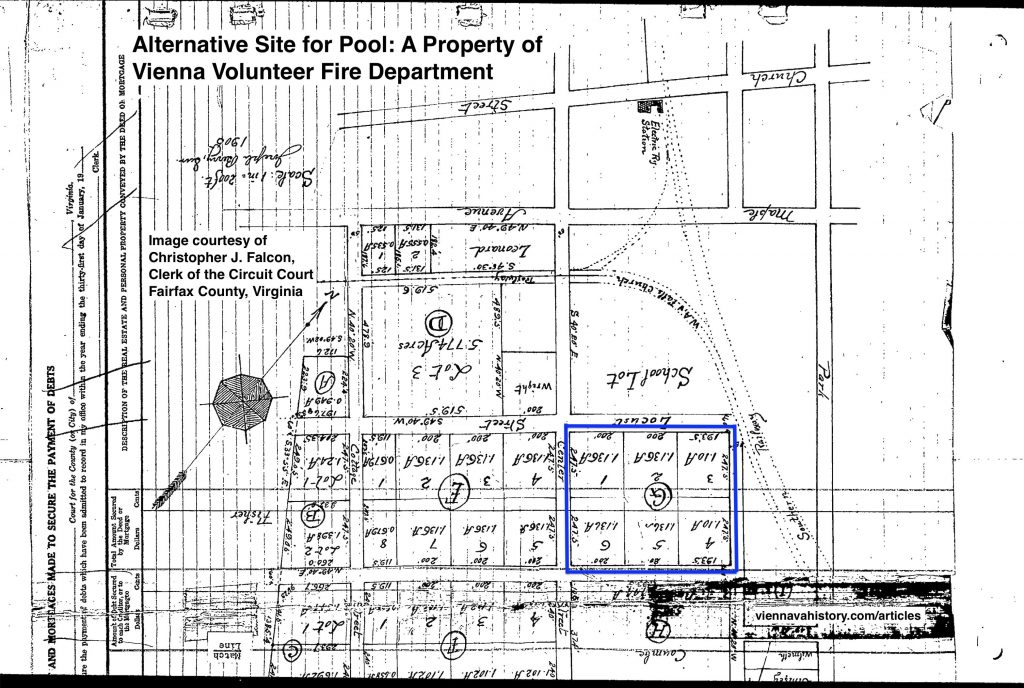
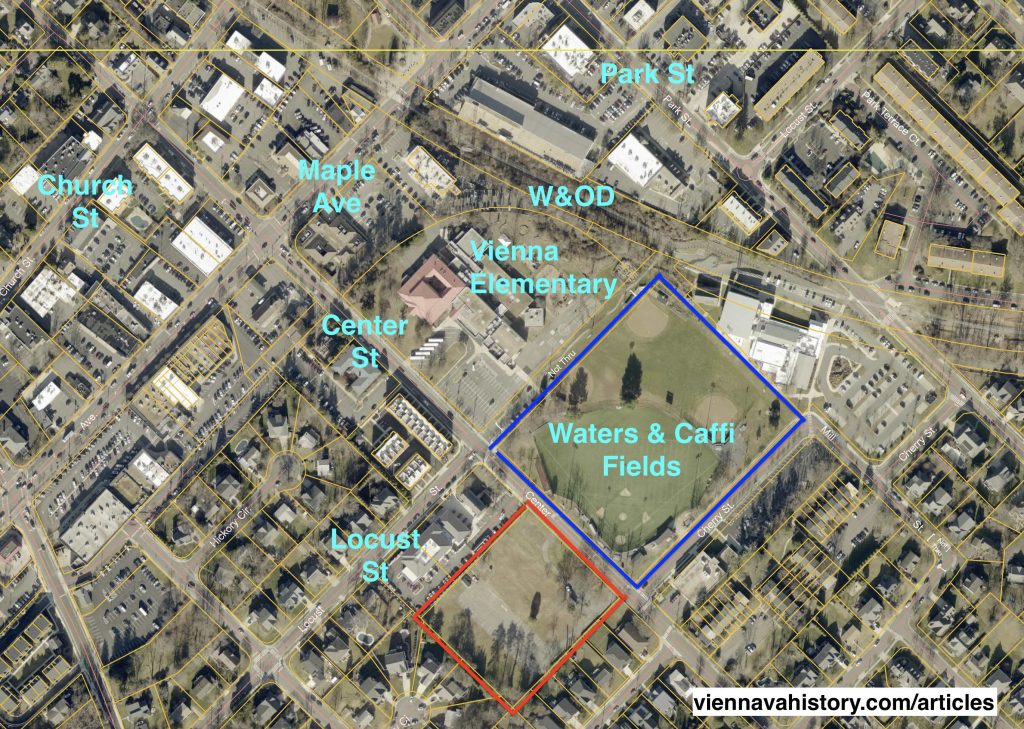
By mid-1950, attention shifted temporarily to the south side of town. The VRA, Vienna’s Town Council, and the Vienna Volunteer Fire Department (VVFD) established a joint committee to weigh constructing recreational and community facilities on a six-acre parcel owned by the VVFD. The VVFD had bought the parcel in 1948 for $5,000. VRA offered VVFD double that amount and proposed to use the tract for a modern swimming pool, full-size athletic field, all-weather play area for children, and large community building. Although this was in line with the recommendation of the joint committee, which included representation from the VVFD, the VVFD in September 1950 voted 10-8 to instead sell the tract to developers.8
Back to Glyndon Park, With A Plan To Add Land For A Pool
After the failure on the south side of town, the VRA returned its attention to the Glyndon Park area. By September 1951, the VRA had negotiated an option to acquire approximately one acre from the Sherwood family, who owned land along the park’s northwestern boundary. The acre would be for the pool. The Town Council agreed to dedicate a strip of parkland—presumably either on the north side of Glyndon Park or the south side of today’s mulch lot—to be an access road for the pool. The Town conditioned its agreement on the VRA’s ability to raise the appropriate funding for the pool.11
Thus at the VRA’s annual meeting for 1951, held in late September, the Board presented a pool plan to the membership for a vote. The pool would be 60-ft by 120-ft in size and use modern purification equipment. The latest cost estimate, characterized in a local press report as “very tentative,” was $35-$50,000. The pool would be built on the acre optioned by the Sherwoods. The plan acknowledged that the pool could only meet a portion of the local area’s need. Consequently, the 32-person VRA Board would regulate attendance to ensure the health, safety, and enjoyment of the users. The plan presumably assumed or envisioned a whites-only membership, given that racial segregation remained the practice in Fairfax County. The VRA’s pool plan also established a funding mechanism in the form of two types of gifts. “Founder” families would give $100, payable in $5 installments. Founders would have the privilege of buying season tickets at half price for the pool’s first five years of operations. “Patron” gifts would be in any amount; VRA would use these funds to pay for swimming lessons and life-saving classes. The target for opening was the summer of 1952.12
Article from Sep 20, 1951 Evening star (Washington, District of Columbia)
The membership voted overwhelmingly to approve the plan. “Construction of Vienna Swimming Pool Assured” is how the Providence Journal headlined the development–prematurely– in its report on the vote. The only cautionary note by the local media, alluding to an issue raised at the annual meeting, was that “[p]riorities for necessary materials are still being issued for such construction….VRA officials feel that the priorities situation may slow the swimming pool project, but that it will not halt it.” The reference to raw material priorities and “the priorities situation” almost certainly related to the Cold War defense industrial mobilization prompted by the Korean war. The relevant legislation, the Defense Production Act of September 1950, gave President Truman the power to establish priorities for allocating materials and eventually included civilian producers within its scope.13
The VRA’s leadership moved quickly to implement the now-approved plan by kicking off a funding drive in early November 1951. The overall goal was $50,000, of which $40,000 would be via “Founder” gifts. Even before the start of the drive, the VRA had received $5,000 in gifts for the pool. These included $25 war bonds donated by Vienna children who had won the securities for their costumes in the Town’s Halloween parade.14
Progress Prompts Pushback
The reality of the funding drive and the membership vote may have catalyzed opposition to the pool. There had been a harbinger in 1948 at the very beginning of the effort to establish the park on Glyndon Street, when some adjacent homeowners objected to the Town Council about the park itself. Whatever the spark, in mid-November 1951, two men who owned properties on Ayr Hill Avenue that bordered the park filed suit in the Circuit Court of Fairfax County to block construction of the pool. The suit argued that the pool would be a nuisance and violate zoning regulations. The VRA countered by citing its research into DC-area pools, its forecast that parking would be more than sufficient, and its plans to regulate membership. The VRA also retained prominent county attorney Robert J. McCandlish, Jr. and accelerated the funding drive.15
 Nov 15, 1951 Evening star (Washington, District of Columbia) Newspapers.com
The suit nonetheless seems to have taken the VRA leadership aback. A few weeks after the filing in court, the VRA held a meeting to enable neighbors to air their opposition and to hear out those who supported a pool but opposed using the park as the site. An official from the National Capital Parks and Planning Commission who had designed Anacostia Park and the Rock Creek Parkway provided his expert opinion: the proposed pool site at the park would be inaccessible and lack enough parking. The VRA’s chief fundraiser reported that gifts had slowed because of the lawsuit. With all this, the VRA’s president pledged that the Board would give full consideration to any proposal for an alternate site with a reasonable cost.16
As 1952 unfolded, the momentum swung back to the proponents for the park pool. In February, the circuit court dismissed the lawsuit as premature: VRA had not yet applied for a building permit or taken any other action for the court to block. Meanwhile, the VRA’s search for alternative sites came up short. A location at the end of Glyndon Street NE was too swampy and would be too costly with the grading, road construction, and rock blasting that it would require. It also had the disadvantage of being at one of Vienna’s boundaries, far away from the opposite side of Town. Another site, next to Vienna Elementary School, was not available for purchase. This presumably was the parcel that VVFD had refused to sell to the VRA in 1950, only to sell it later that year to the county’s school board in response to the school board’s pressure that it not be sold to developers. With no alternative available, in March, the VRA leadership returned to the original plan of building at the park on Glyndon Street and resumed the funding drive. On 21 March 1952, the VRA “announced the purchase from Mr. Joseph Sherwood of one acre of land adjacent to the Vienna Park,” according to the Fairfax Standard.17
 01 Feb 1952, Fri Evening star (Washington, District of Columbia) Newspapers.com
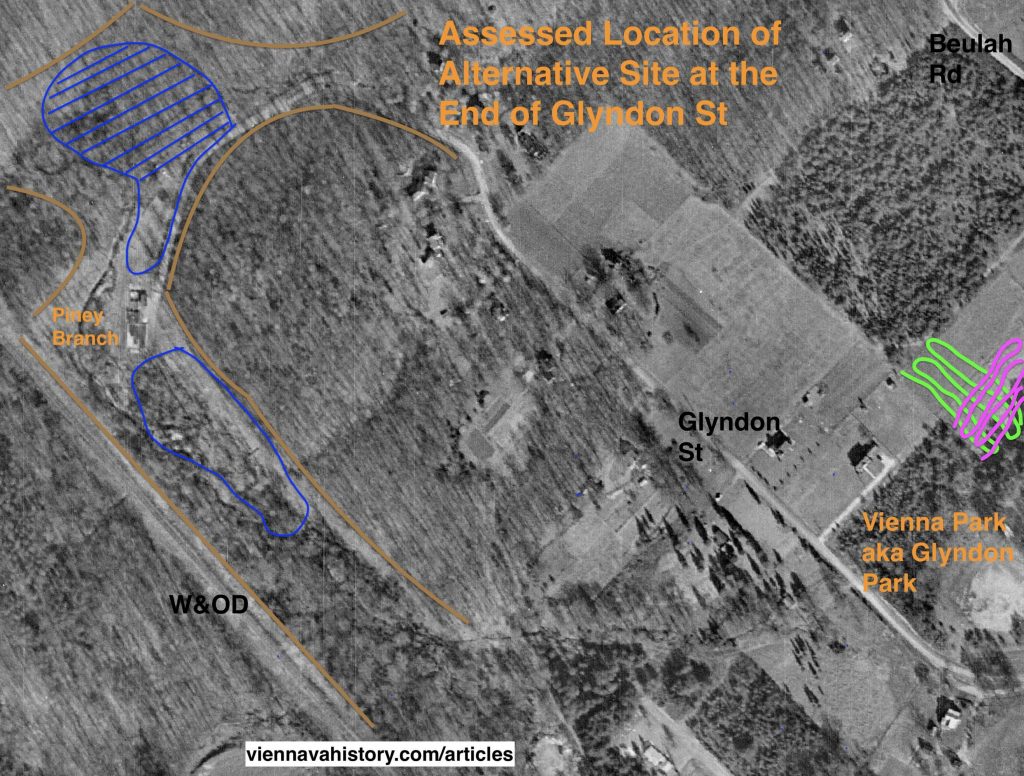
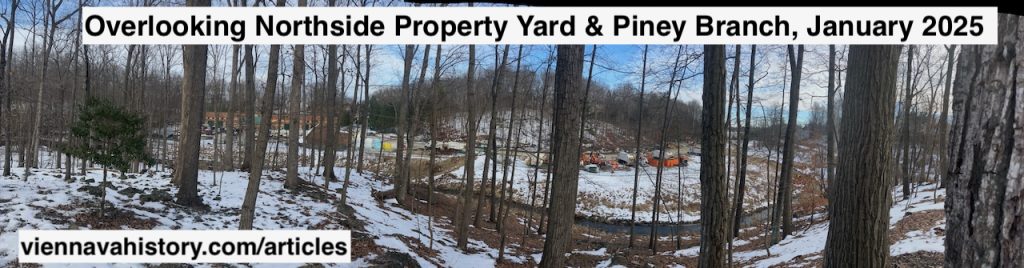
So what happened, given that the pool was never built? In fact, as far as I can tell from reviewing deeds involving Joseph Sherwood and deeds involving the VRA, the purchase announced in March, 1952 was never consummated. The farthest it appears to have progressed was the transfer of funds from the VRA to the settlement attorney.19
I suspect that a public fracture within the VRA and its leadership delayed the effort and that the opposition used the delay to organize and lobby. In late April 1952, one month after the purchase announcement, differences within the leadership were vented publicly when pool opponents published “An Open Letter To The Membership Of The Vienna Recreation Association” in the Providence Journal newspaper. The letter had some 60 signatures, the first of whom was a member of the VRA’s site committee for the pool and a nearby property owner. The chief fundraiser was also a signatory. Some local heavy-hitters signed. These included a recent Vienna mayor, a recent Town councilman, a man who would become a Town councilman a few months later, and Katrina Hine Echols, the daughter of Vienna’s first mayor and at the time still a significant property owner in the Vienna area.20
The substance of the letter’s argument oriented on the unsuitability of the pool for the particular neighborhood—parking, noise, and home values—and culminated with an appeal to the membership’s empathy. “We feel sure that those of you who love your homes and privacy would not wish to have such problems forced upon you,” the authors wrote.
The Family Who Almost Had A Pool In Their Backyard
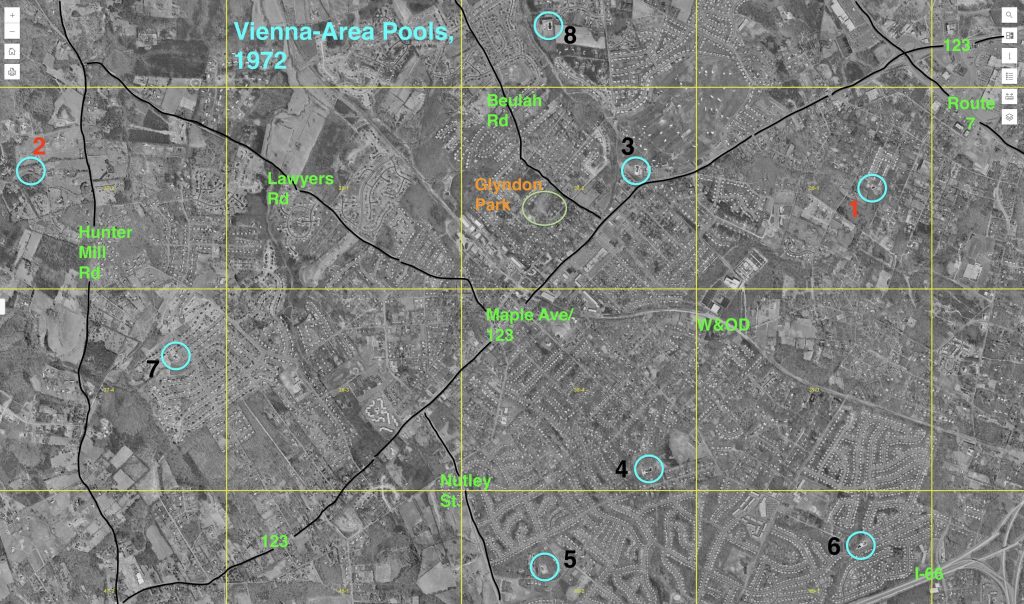
A number of signatories of the open letter owned property abutting the park or sitting near it, but the closest of these to the pool were Stanley and Florence Andrews. They almost certainly are the owners of the “house within 75 feet of the proposed pool site” referred to in the letter, judging from property records and aerial imagery from 1953 (see the house circled in red in an earlier graphic in this article). The Andrews family acquired the property in early 1951 from Charles and Flossie Vernon. Given that timing, perhaps the Vernons sold to avoid the pool and a perceived potential impact on their property value. The Andrews family owned the lot for just a short time, selling in 1954. In their case, perhaps the pool controversy that had blossomed early in their ownership convinced them to avoid the risk of the pool idea returning.21
The substantive issues in the letter had been aired before. However, the letter also introduced a process argument with an implicit complaint against those in the VRA leadership who were advocating for the park site for the pool: “We feel sure that the VRA membership, at large, is unaware of the opposition which we have voiced to the small group of officers of that association who are actively promoting this pool location.”
The letter closed with a promise of continued opposition if the VRA persisted. “These serious consequences of the proposed swimming pool compel us to continue our opposition by whatever equitable means are available to us.” 22
Coincident with this rallying of the opposition were sad, impactful developments within the ranks of the proponents. One of the men publicly credited as a key backer for the pool died three weeks before the publication of the open letter. Within months, another man who was a driving force for the pool was probably sidelined because of a serious illness within the family. 23
The VRA Campaign Fails
In May 1952, the VRA Board elected a new president and, despite the open letter, decided to apply for a permit to build the pool on the Sherwood parcel. At the same time, though, a motion passed to approach Fairfax County about acquiring school property or other public lands for a pool, probably to demonstrate good faith in response to the opposition’s complaints in the letter. Unsurprisingly, that didn’t pan out. Thus in mid-August 1952, the VRA applied for a permit to build a pool on the land that was adjacent to the park and zoned for residential use. At that point, the project’s estimated cost was $45,000, with $30,000 of that for a 35-ft by 70-ft pool and the remainder for features such as a wading pool, bathhouse, and lighting. Interestingly, the VRA at this point was emphasizing the private nature of the pool, whereas earlier media reporting had characterized it in a public context.24
I’m unable to find information about the fate of the permit request. However, the subject was taken to the Town’s Board of Zoning Appeals in September 1952. The question facing the appeals board was “whether or not the [VRA] would be considered a private club and entitled to build a ‘pool and building for recreational use of members of VRA, a private club, not operated for profit’ in a residentially zoned area.” The Zoning Appeals Board vowed a decision within 15 days. Various newspapers in Fairfax County and Washington that had carried stories on the pool don’t seem to have covered the outcome of the appeal.25
Nonetheless, the zoning board’s decision must have gone against the pool, because months later, in April 1953, the VRA gave up. The organization’s leadership decided to abandon the pursuit of a pool at the park. Although the president made a nod to the idea of continuing to search for a pool that, as the Fairfax Standard put it, “will be satisfactory to all Vienna residents,” there’s no evidence in the local press of such an effort. Regardless, if there was, it’s clear nothing panned out.26
Conclusion
The key factor in derailing a pool at Glyndon part was the opposition of the local neighborhood. It helped the opposition that their ranks included VRA members who held leadership positions and supported the idea of a pool–but somewhere else. The need to change what was permitted in residential zoning to accomodate a pool was almost certainly a contributing cause. It would have given the opponents something concrete to block the pool’s proponents. If the opposition could prevent a change in the zoning status quo, then they wouldn’t need to rely on the empathy of members who didn’t live in the neighborhood and who wouldn’t have the same stakes in the matter.
On the broader issue of a pool anywhere in Vienna, what was decisive was the VVFD’s vote in 1950 against selling their six-acre parcel to the VRA. Had two VVFD members voted differently, a pool on this parcel would have stood a greater chance of getting built than one at Glyndon Park, as evidenced by the recreational purpose that the former VVFD parcel has today. Moreover, in the early ’50s, there was less residential development in the immediate area of the VVFD parcel than there was Glyndon Park, and thus fewer homeowners to object to a pool in their backyard.
Epilogue
The establishment of various private pool clubs in the Vienna area as the ’50s progressed probably reduced demand for a municipal facility. The first of these pools to be announced was for what we know today as the Westwood Country Club, then a semi-private establishment. In August 1953, just a few months after VRA dropped the plan for a pool at the park, construction began for the country club. At the time, the club publicized its plan to build an Olympic-sized swimming pool and a wading pool at the facility. Thus the local community would have been aware that a pool was coming to Vienna after all, despite the failure of the VRA effort. More than a decade would elapse before the Town of Vienna began the second campaign for a Vienna public pool. That will be the subject of Part 2.29
Notes on Sources
All the cited newspapers articles were accessed via the Library of Virginia’s Virginia Chronicle website, except the Evening Star and the Washington Post, which were accessed via Newspapers.com and the Fairfax County Public Libary, respectively. Because of some sort of glitch, the endnote numbering that you see won’t go into double-digits in the list of endnotes, and thus those numbers recycle as single digits as the endnotes progress in the list. Consequently, if you click on Endnote 23 in the body of the text, you are brought to the third endote 3 in the list of endnotes. My apologies for the frustrating inconvenience. Clicking on the citation in the body of the text nonetheless brings you to the correct endnote.
- Woolsey, Angela. “Vienna dreams of a pool to replace former Faith Baptist Church, which may be demolished,” FFX Now, 10 May 2023. ↩︎
- Untitled article about American Legion and Lions Club pool plans, Washington Post, 20 August 1948, p14. Fairfax County Deed 649:67. ↩︎
- “Vienna Civic Groups Organize to Promote Community Playground,” Providence Journal, p1, 2 September 1948. “Vienna Park Ready For Use This Summer,” Providence Journal, 19 May 1949, p1. ↩︎
- “Organizations May Use Vienna Community Park,” Fairfax Standard, 5 November 1948, p1. “Campaign To Finance Pool To Be Launched at Vienna,” 21 January 1949, Fairfax Standard, p1. ↩︎
- Untitled article about community center goal of the VRA, Providence Journal, 17 February 1949, p12. “Vienna Park Construction Date Is Set,” Fairfax Standard, 6 May 1949, p1 and continued on p4. ↩︎
- “Vienna Studies Recreation,” Fairfax Standard, 25 February 1949, p2. ↩︎
- “Vienna Studies Recreation,” Fairfax Standard, 25 February 1949, p2. “Vienna Recreation Group Seeks More Land,” Providence Journal, 14 July 1949, p6. Fairfax County Deed O11:514. ↩︎
- “Vienna Park Shows Year Of Progress Team Work Does It, Says VRA,” Fairfax Standard, 25 August 1950, p1. 660:393. “Vienna Fire Dept. Sells Play Area,” Fairfax Standard, 29 September 1950, p1. (The sale to developers never worked out, given that the land today is used for recreation purposes). ↩︎
- G6:509. Stuntz, Connie Pendleton and Stuntz, Mayo Sturdevant, “This Was Vienna Virginia: Facts and Photos,” 1987, p255. ↩︎
- “Vienna Fire Dept. Sells Play Area,” Fairfax Standard, 29 September 1950, p1. “Town of Vienna Annex Long-Term Use Study Presentation,” 30 September 2024. ↩︎
- “VRA Plans A Swimming Pool,” Fairfax Standard, 21 September 1951, p1. “Financing of Vienna Pool To Be Discussed Tonight,” Evening Star, 20 September 1951, p31. ↩︎
- “Construction Of Vienna Swimming Pool Assured,” Providence Journal, 27 September 1951, p1. “Vienna Recreation Group To Campaign For Building Swimming Pool Next Year,” Falls Church Echo, 28 September 1951, p1. “The Town of Vienna’s Role in Select Racial Covenants in the 1940s,” viennavahistory.com, 11 February 2025, https://viennavahistory.com/2025/02/11/the-town-of-viennas-role-in-select-racial-covenants-in-the-1940s/ “Mapping Racial Covenants,” Documenting Exclusion & Resilience. February 11, 2025. https://documentingexclusion.org/mapping-nova/) ↩︎
- “Construction Of Vienna Swimming Pool Assured,” Providence Journal, 27 September 1951, p1. “Vienna Recreation Group To Campaign For Building Swimming Pool Next Year,” Falls Church Echo, 28 September 1951, p1. Neenan, Alexandra G., “The Defense Production Act of 1950: History, Authorities, and Considerations for Congress,” Congressional Research Service, 6 October 2023. ↩︎
- “VRA Pool Fund Drive Aided By Children’s Prize,” Providence Journal, 8 November 1951, p1. ↩︎
- “Vienna Civic Groups Organize To Promote Community Playground,” Providence Journal, p1, 2 September 1948. “Two File Suit to Block Vienna Swimming Pool,” Evening Star, 15 November 1951, p41. “Vienna Recreation Association Defends Swimming Pool Site,” Providence Journal, 29 November 1951, p2. “Vienna Group Steps Up Pool Drive,” Providence Journal, 6 December 1951, p8. ↩︎
- “Alternate Sites For Vienna Pool Will Be Considered, Says VRA Head,” Providence Journal, 27 December 1951, p1. “Anacostia Park, National Capital Parks–East, Cultural Landscapes Inventory, National Park Service,” Urban Heritage Project/PennPraxis, University of Pennsylvania, April 2021, p125. ↩︎
- “Suit to Bar Vienna Pool Dismissed as ‘Premature’,” Evening Star, 1 February 1952, p29. “Suit Dismissal Advances Pool,” Falls Church Echo, 7 March 1952, p1. “Vienna Fire Dept. Sells Play Area,” Fairfax Standard, 29 September 1950, p1.”Property Adjoining Vienna Park Bought For Swimming Pool,” Providence Journal, 20 March 1952, p4. “VRA Purchases Acre Of Land,” Fairfax Standard, 21 March 1952, p1. Deed 812:95. ↩︎
- “Suit Dismissal Advances Pool,” Falls Church Echo, 7 March 1952, p1. ↩︎
- Review of Fairfax County deeds with Joseph Sherwood as the grantor and, separately, those with the VRA as the grantee. “Property Adjoining Vienna Park Bought For Swimming Pool,” Providence Journal, 20 March 1952, p4. ↩︎
- “An Open Letter To The Membership Of The Vienna Recreation Association,” Providence Journal, 24 April 1952, p2. “E.E. Cockrill Elected Mayor Of Vienna,” 13 June 1946, p1 (recent mayor: Elmer Cockrill). “Nichols Elected Mayor Of Vienna; Graham Reelected In Fairfax,” Providence Journal, 10June 1948, p1 (recent councilman: L.N. Sherburne). “Moore Elected Mayor Of Vienna, Walker Reelected In Fairfax,” Providence Journal, 12 June 1952, p1 (future councilman: Ward Freeman). ↩︎
- Open Letter, Providence Journal, 24 April 1952, p2. 1153:515. 863:77. ↩︎
- Open Letter, Providence Journal, 24 April 1952, p2. ↩︎
- “Hugh West Gunnell, Of Pioneer Fairfax County Family, Dies In Vienna,” Providence Journal, 3 April 1952, p1. “Property Adjoining Vienna Park Bought For Swimming Pool,” Providence Journal, 20 March 1952, p4. Pollard, Rosemary. “Vienna Varieties,” 10 October 1952, p5. Unititled item, Fairfax Herald, 25 June 1954, p1. “Vienna Pool Campaign To Start Soon,” Providence Journal, 1 November 1951, p1. ↩︎
- “VRA To Apply For Permit To Build Swimming Pool,” 8 May 1952, Providence Journal, p1. “VRA Details On Swimming Pool,” Fairfax Standard, 22 August 1952, p3. “Vienna Group Steps Up Pool Drive,” Providence Journal, 6 December 1951, p8. “Vienna Studies Recreation,” Fairfax Standard, 25 February 1949, p2. ↩︎
- “Vienna: Town Hall News,” Fairfax Standard, 26 September 1952, p10. ↩︎
- Pollard, Rosemary, “Vienna Varieties,” Fairfax Standard, 1 May 1953 p2. ↩︎
- “An Open Letter To The Membership Of The Vienna Recreation Association,” Providence Journal, 24 April 1952, p2. “Suit Dismissal Advances Pool,” Falls Church Echo, 7 March 1952, p1. “Vienna Recreation Group Seeks More Land,” Providence Journal, 14 July 1949, p6. ↩︎
- Roussey, Tom, “Pickleball battle: Va. community divided on restricting the sport due to noise complaints,” WJLA, 23 January 2023. Woolsey, Angela, “Vienna Police cite pickleball players for making racket at Glyndon Park,” FFX Now, 29 August 2022. ↩︎
- “Work On Golf Club Near Vienna Now Underway,” Providence Journal, 21 August 1953, p12. ↩︎
- “Freedom Park Pool Is Open,” Fairfax Falls Church Sun Echo, 3 June 1955, p6; the Freedom Park page at the website of the Northern Virginia Swimming League (there are no meet results for the pool after 1991); a post of the Freedom Park Pool Alumni Facebook page dated 20 July 2021. Lynch, Artelia, “Vienna Varieties,” Fairfax Standard, 3 February 1956; “History of Hunters Valley,” website for Hunters Valley Association, undated. Palen, Christopher J., “The History of Westwood Country Club, Vienna, Virginia,” undated, but completed no earlier than November 2024, p15. “Vienna Woods Swimming Pool” ad/notice, Providence Journal, 19 September 1958, p2. “Aquatic Facility Opened,” Northern Virginia Sun, 12 September 1961, pA2. “Newest Pool In Fairfax County,” Fairfax Falls Church Sun Echo, 9 August 1962, p6. “Swim League Sets Meeting For Officials,” Northern Virginia Sun, 5 June 1968, p9. “June 1988 — Four New RECenters Open,” Timeline, History of the Fairfax County Park Authority. ↩︎
When can we expect Part 2? As you may know the Vienna Pool has emerged again and is a hot topic in ToV.
Thanks for your interest, which motivated me to push this past weekend. Part 2 is now available: https://viennavahistory.com/2026/03/31/the-vienna-pool-part-2-an-issue-across-75-years/
Excellent article. Thank you.
Thank you for your thorough research on Vienna history. It’s always so interesting.
Thanks for this excellent article! Looking forward to Part 2
Exceptional research, assume you used AI to track all? Quite the time-line of the local political process. Thank you!
Thank you for reading & commenting. My research was largely through iterative searches in Fairfax County newspapers of the era, via the Library of Virginia’s Virginia Chronicle website. Plus searches of the Washington Post via the county library’s website and the (Washington) Evening Star via newspapers.com and the Libary of Congress Chronicling America site. Searches such as “Vienna” and “pool”, “VRA” and “pool,” etc., rather than AI. Then followed up on leads with more targeted searches. Thanks again!